Breaking News
Main Menu

Linear Regression In Excel For Mac
среда 30 января admin 54
Charles, Thanks for all the interesting information you have available here. I’m relatively new to regressions and I’m hoping you can give me your thoughts on the following: I’m trying to roughly estimate/predict what the hourly energy prices ($/MWh), at a certain grid point, will be going forward, out 12 months. The issue I’m having is that the price I’m trying to estimate, lets call it “Price A”, is relatively new, with only 6 months of hourly historical prices available. Knowing that this price is highly correlated to a different price (r = 0.98 and r-squared = 95%), let’s call it “Price B”, and that Price B does have available historical data going back multiple years, here’s what I’ve done: calculated in Excel, using the equation y=m*x+a (where y = price A and x = price B) and parameters calculated in Excel (“m” and “a”), what the prices would had been at point A, let’s say for the last 12 months. Essentially, I would appreciate if you could tell me whether or not this is valid approach and also what would I should be doing next to estimate the prices for the next 12 months. 
I hope this isn’t too confusing, please let me know otherwise. Thank you in advance. Dear Charles: I found a little bug in the residuals and Cook’s D sections (when that options are selected in linear regression analysis): 1. There´s a section at the right of the Cook’s D table that calculates dfE (degrees of freedom of errors) substracting (k+1) instead of substracting k. Because of that, there’s a difference between Data Analysis Excel Add-in results and Real Statistics 2.16.1 results in the calculation of Standard Residuals (SResidual in Cook’s D table).
Also, for that reason, there are some mistakes in the calculation of: ModMSE, RStudent, T-Test, Cook’s D, and DFFITS columns in Cook’s D table. I hope these comments will be helpful. William agurto.
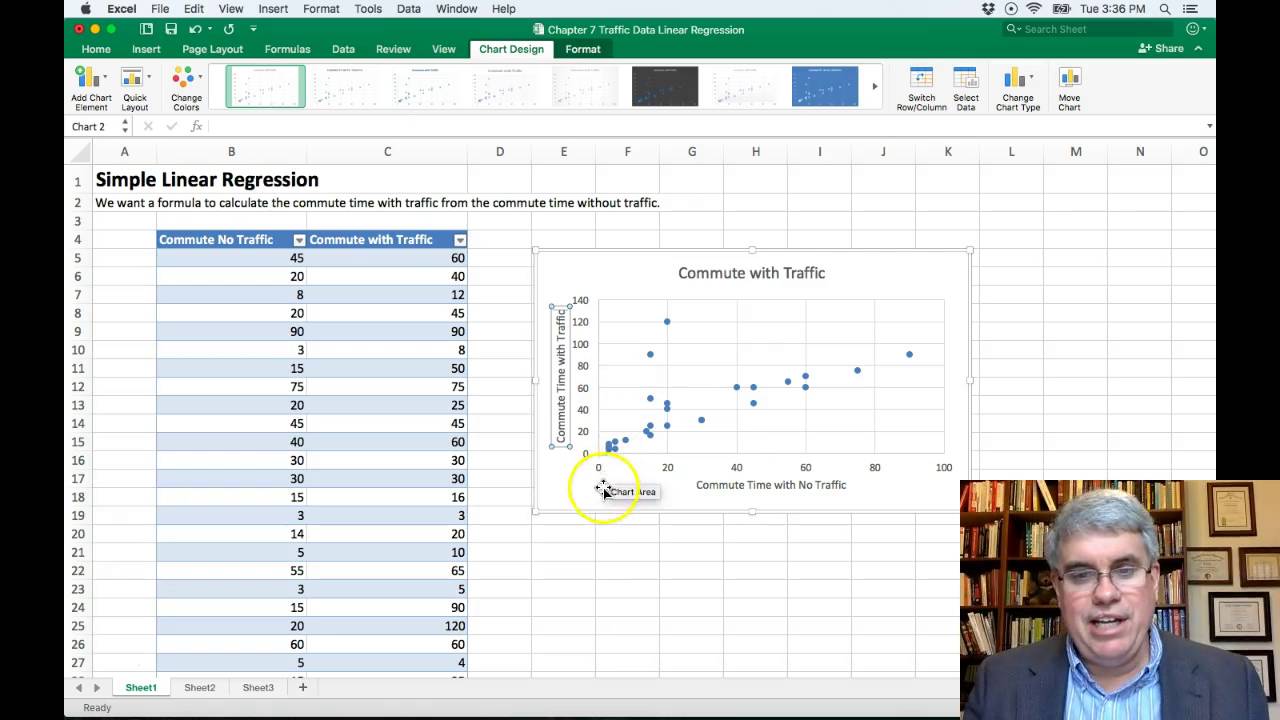
It is also standard with the 2016 or later Mac version of Excel. However, it is not standard with earlier versions of Excel for Mac. WEEK 1 Module 1: Regression Analysis: An Introduction In this module you will get introduced to the Linear Regression Model. We will build a regression model and estimate it using Excel. A linear regression is a data plot that graphs the linear relationship between an independent and a dependent variable. It is typically used to visually show the strength of the relationship,.
Dear Charles: The bug in the SResidual calculation is still unfixed in Real Statistics 2.17. I present an example for making the explanation simpler: 1.
Data for analysis: X Y 9 0.98 14 0.96 25 0.94 30 0.92 59 0.9 122 0.88 128 0.86 138 0.84 144 0.82 2. Results obtained in Excel 2010 (using Data Analysis Add-in) for RESIDUAL OUTPUT: Observation Predicted Y Residuals Standard Residuals 1 0.959434128 0.020565872 1.305567744 2 0.954885598 0.005114402 0.324673749 3 0.944878831 -0.004878831 -0.309719156 4 0.940330301 -0.020330301 -1.290613152 5 0.913948826 -0.013948826 -0.885502786 6 0.856637346 0.023362654 1.483113757 7 0.851179109 0.008820891 0.559969944 8 0.842082049 -0.002082049 -0.132173143 9 0.836623813 -0.016623813 -1.055316957 3. Results obtained in Real Statistics 2.17 for Cook’s D Table (only columns 1, and 4 to 7 are shown): Obs Pred Y Residual Leverage SResidual 1 0.959434128 0.020565872 0.271566883 1.221246799 2 0.954885598 0.005114402 0.247947105 0.303704483 3 0.944878831 -0.004878831 0.202599637 -0.289715742 4 0.940330301 -0.020330301 0.184994445 -1.207258058 5 0.913948826 -0.013948826 0.11994921 -0.82831201 6 0.856637346 0.023362654 0.1965224 1.387325886 7 0.851179109 0.008820891 0.219377825 0.523803919 8 0.842082049 -0.002082049 0.263484784 -0.123636654 9 0.836623813 -0.016623813 0.293557711 -0.987158622 4. As you see, the Standard residuals obtained by Data Analysis Add-in is different from those obtained in Real Statistics 2.17. As I commented in the prior message, this is because Real Statistics 2.17 calculates dfE (degrees of freedom of errors) substracting (k+1) instead of substracting k (in the example, 7 instead of 8). When I manually correct this difference (I write 8 instead of 7), all the standard residuals are OK.